
How Often Should You Service an Electric Golf Cart? A DFW Owner’s Guide
Most golf cart owners in Plano, Frisco, McKinney, and Allen think about service the same way most people think about going to the dentist — they wait until something hurts. By then the problem is usually bigger and more expensive than it would have been if they’d just kept up with regular maintenance.
The good news is that electric golf carts are genuinely simple machines compared to cars. They have fewer moving parts, no oil changes, no spark plugs, and no fuel system to worry about. But they do have specific maintenance needs — particularly around the battery, brakes, and electrical system — and in North Texas, where summers regularly push above 100°F, those needs are more pressing than they are in milder climates.
This guide covers exactly how often to service your electric golf cart, what gets done at each interval, and what Galaxy Golf Cars does when our mobile service team comes to you.
The Short Answer
Most golf cart manufacturers recommend professional service every six to twelve months or every 100 to 200 hours of operation — whichever comes first. For DFW residents who use their cart daily for neighborhood errands, school pickups, and community driving, that typically means a professional visit at least once a year, and more frequently if the cart is a heavy daily driver.
Between professional visits, there are monthly checks any owner can do themselves in under ten minutes. Carts that follow a consistent maintenance schedule typically last fifteen to twenty years or more. Carts that skip it routinely need major repairs within four to five years.
The difference in long-term cost is significant. Annual maintenance done consistently runs a fraction of what a neglected cart costs in repairs and premature battery replacement.
Why DFW’s Climate Makes Regular Service More Critical
North Texas heat is genuinely harder on golf carts than the mild climates most manufacturer maintenance guidelines are written around. Average summer highs in the Plano area run between 90 and 100°F, and triple digit days happen regularly from June through September.
For electric golf carts, extreme heat accelerates battery degradation, speeds up terminal corrosion, and stresses tires beyond what owners experience in cooler climates. In hot weather, lead-acid battery water evaporates faster, meaning water levels need checking more frequently than the standard monthly recommendation. UV exposure degrades exterior surfaces, seat materials, and plastics faster when a cart sits outside in direct Texas sun without a cover.
The practical implication for DFW owners is simple: what works as a once-a-year service cadence in a mild climate may not be enough here. Heavy summer use combined with high heat means your cart needs more attention in June, July, and August than at any other point in the year.
The DFW Golf Cart Maintenance Schedule
Monthly — Owner Tasks (10 Minutes)
These are quick checks any cart owner can do without tools or technical knowledge:
Battery terminals — Look for white, blue, or greenish corrosion around the connection points. If you see buildup, clean it with a baking soda and water solution, rinse, dry, and apply terminal protectant. In DFW heat, corrosion builds up faster than most owners expect. Check every month without fail.
Battery water levels (lead-acid only) — If your cart has lead-acid batteries, check water levels monthly and more frequently in summer. Add distilled water only — never tap water, which contains minerals that damage battery plates. Fill to the manufacturer’s specified level after charging, not before.
Tire pressure — Golf cart tires should generally be inflated to 18–22 PSI. Check monthly. Hot pavement causes tire pressure to rise, and underinflated tires reduce range, increase wear, and affect handling.
Brake feel — Press the brake while parked and notice whether it feels responsive and firm. Any sponginess, pulling to one side, or grinding sounds during braking are signals to call for service.
Visual inspection — Look for anything that looks or sounds different from normal. Strange noises during operation, flickering lights, or accessories that stop working are all worth noting and addressing promptly.
Quarterly — Closer Look (Every 3 Months)
Every three months, go a little deeper:
Clean and tighten battery connections — Even if there’s no visible corrosion, check that all battery cable connections are fully tight. Loose connections create resistance and drain the battery faster.
Inspect charger operation — Verify the charger is functioning correctly and reaching full charge. An old or incompatible charger that doesn’t reach proper output voltage means the battery starts every ride already partially depleted.
Check steering and suspension — Feel for any looseness, wobble, or pulling in the steering. Inspect visible suspension components for wear or damage.
Lubricate moving parts — Steering components and other moving parts benefit from periodic lubrication. Refer to your owner’s manual for the specific points and products recommended for your model.
Annually — Professional Service Visit
Once a year — or more frequently for heavy-use carts — your cart needs a professional inspection that covers the components that are difficult or impossible to self-diagnose:
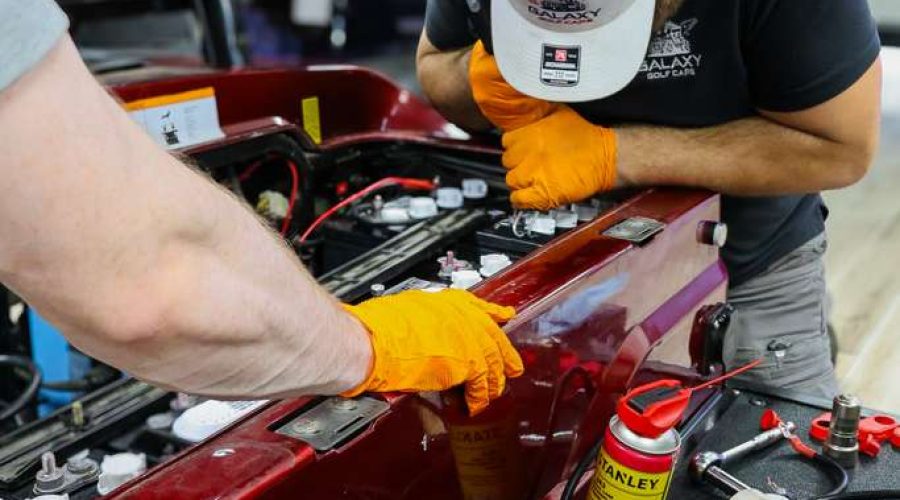
Full battery load test — Not just a resting voltage reading, but a proper test under operating conditions that measures actual available capacity. This is the only test that reliably identifies whether a battery is approaching end of life.
Brake system inspection — A complete check of brake pads, cables, drums, and adjustment. Given that most golf carts operate at speeds up to 25 mph, brakes are a safety-critical item that should be professionally inspected annually.
Electrical system check — Testing solenoid function, fuse condition, wiring integrity, grounds, and controller operation. Electrical faults in these components develop silently and can escalate into controller and motor damage if left unaddressed.
Suspension and front-end inspection — Checking bearings, bushings, and alignment. Worn suspension components produce clunking, steering wander, and uneven tire wear long before most owners connect the symptom to the cause.
Charger output test — Verifying the charger is delivering the correct voltage and operating correctly with the battery type installed.
Full operational check — Testing all lights, turn signals, horn, mirrors, and safety features to ensure everything works correctly.
Signs You Need Service Before Your Annual Visit
Don’t wait for the scheduled date if you notice any of these:
● Range has decreased noticeably — you’re covering less ground per charge than before
● The cart is slow to start or hesitant when you press the accelerator
● Strange noises — clicking, grinding, squealing, or rattling during operation
● The battery is losing charge while the cart sits unused
● Brakes feel spongy, make noise, or pull to one side
● Lights flicker, accessories stop working, or fuses blow repeatedly
● The charger is getting hot, shutting off early, or not completing a full charge cycle
Any one of these warrants a service visit sooner rather than later. Small issues caught early cost a fraction of what they cost after they escalate.
How Galaxy Golf Cars Handles This — On-Site Mobile Service
Galaxy Golf Cars offers a $149 mobile diagnostic visit where our technician comes directly to your home, community, or property anywhere in DFW. We perform a full inspection — battery load test, electrical system check, brake inspection, charger verification, suspension check, and complete operational review — and give you a clear, written assessment of everything we find.
If you decide to move forward with any of the recommended repairs on the same visit, we credit $50 back toward the work. You pay $99 net for the diagnostic, and the full cost of the inspection applies toward getting your cart back in shape.
There’s no obligation to proceed with any repairs after the diagnostic. We’ll give you an honest assessment and let you decide what makes sense. But for most cart owners who haven’t had a professional look at their cart in over a year, the diagnostic alone is worth it — it tells you exactly where you stand before something fails unexpectedly on a 100-degree July afternoon.
Booking Is Simple
Call or text us, describe your cart and when you last had it serviced, and we’ll schedule a mobile visit at a time that works for you. We serve Plano, Frisco, Allen, McKinney, Prosper, Celina, Little Elm, Richardson, Garland, and all of Collin County.
📞 (972) 476-3343
🌐 galaxygolfcars.com
📍 1721 N Central Expy, Plano TX 75075
Contact Galaxy Golf Cars Today
📍 1721 N Central Expy, Plano TX 75075
GalaxyGolfCars.com