
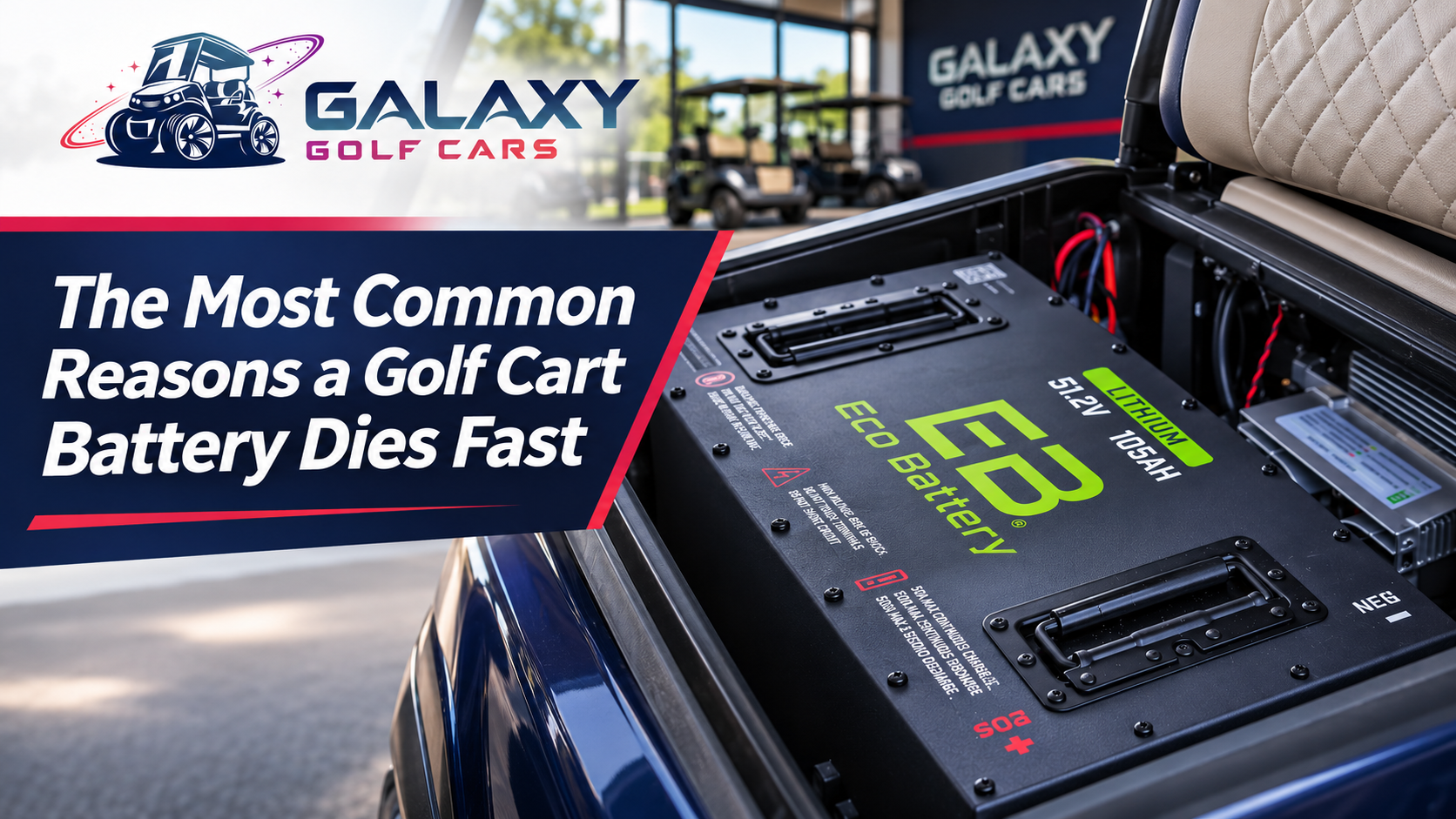
The Most Common Reasons a Golf Cart Battery Dies Fast
Few things are more frustrating than a golf cart battery that dies fast — the cart that used to run all day now limps home, or worse, loses charge sitting in the garage overnight. The good news: fast battery drain almost always has a specific, findable cause, and it is not always the battery itself.
Here are the six most common reasons we find on service calls across DFW, how to tell whether your battery is actually the problem, and what fixing each one involves.
1The Battery Is Old or Has Degraded Cells
Age is the most straightforward cause. Over time and hundreds of charge cycles, battery cells lose capacity. One of the most common issues is sulfation — when lead sulfate crystals form on the battery plates during normal use. If the battery is not fully and promptly recharged after each use, those soft crystals harden and permanently reduce the plate surface area available for the chemical reaction that generates power. Once sulfation progresses past the early stages, it cannot be reversed.
A battery that looks fine on a surface voltage check may be failing under load. A proper load test — not just a resting voltage reading — is the only way to know for sure.
2Corroded or Loose Battery Terminals
This one is surprisingly common and often misdiagnosed as a battery failure when it is not. The terminals control electrical flow — if they are corroded (white, blue, or greenish buildup around the connections) or not fully tight, resistance builds up in the circuit. Less power reaches the motor, the battery works harder to compensate, and it drains faster than it should.
In North Texas, heat and humidity accelerate terminal corrosion significantly. A cart with clean terminals in spring can have meaningful buildup by midsummer. Cleaning and treating the terminals is a simple fix that sometimes resolves what looks like a battery problem entirely.
3A Faulty or Mismatched Charger
The charger is one of the most overlooked causes of fast battery drain — and battery damage. Not all chargers are compatible with all battery types. A charger that does not provide the proper voltage can deteriorate battery health quickly, and an old charger that no longer reaches full output voltage means the battery never actually reaches a full charge — so it starts every ride already depleted.
Overcharging is equally damaging. Leaving a battery on a non-automatic charger for extended periods damages the cells. A quality automatic charger that shuts off at capacity is a basic requirement for battery longevity.
4Deep Discharging
Running your battery completely dead — or close to it — on a regular basis causes irreversible damage to the internal cells, especially with lead-acid batteries. Unlike consumer electronics, golf cart batteries should be charged after every use, not run down until they stop.
For lithium batteries, consistently draining below 20% also accelerates long-term degradation. Topping up regularly, rather than waiting for the battery to get low, extends the life of the pack significantly.
5A Parasitic Drain
When you turn your golf cart off, the battery should stop discharging. But sometimes it does not. A short circuit somewhere in the electrical system — loose wires, a damaged component, or an accessory that was added improperly — can cause a slow but continuous draw even while the cart is parked. A cart that loses significant charge sitting overnight with no use almost always has a parasitic drain somewhere in the system.
This type of issue is harder to self-diagnose because it does not show up as an obvious failure. It takes a technician with a voltmeter and knowledge of where to look in the electrical system to find it.
6Excessive Accessories or Power Demands
Aftermarket accessories — added lighting, stereos, phone chargers, lift kits that require bigger motors — all draw power beyond what the system was designed to handle. If accessories were added without upgrading the battery system to match, you are drawing more power than the pack was sized for, which drains it faster and stresses the cells with every ride.
Is It the Battery — or Something Else?
Before assuming the battery needs replacing, it is worth knowing which way the evidence points:
The Battery Is Likely the Problem If…
- Range has decreased gradually over many months or years
- The cart is older and the battery pack has never been replaced
- It will not hold a charge even after a full overnight charge
- The cart gets weaker toward the end of every ride
Something Else Is Draining It If…
- ✕The battery was recently replaced or is relatively new
- ✕The cart loses charge sitting overnight without being used
- ✕The problem appeared suddenly rather than gradually
- ✕Range dropped significantly after a new accessory was added
What a Galaxy Battery Service Visit Covers
When our mobile service team comes to your location in Plano, Frisco, McKinney, Allen, or anywhere across DFW, a battery visit covers:
- Full battery load test — not just resting voltage, but performance under operating conditions. This is the only test that tells you whether the battery actually has the capacity it is supposed to have.
- Terminal inspection and cleaning — every terminal checked for corrosion, cleaned and treated, with all connections confirmed tight and secure.
- Charger inspection — verifying the charger reaches proper output voltage and is compatible with your battery type.
- Parasitic drain check — if the cart loses charge while parked, we trace the draw with a voltmeter through the electrical system.
- Honest assessment — if the battery needs replacing, we say so clearly; if it does not, we say that too. We carry replacement batteries on the service vehicle for common configurations and can often handle the swap the same visit.
For carts that need a battery upgrade — from lead-acid to lithium, or from an aging lithium pack to a new one — we can quote the replacement on-site and schedule the work for the same or next visit.
When to Replace vs. When to Repair
If your battery is within its expected lifespan and the load test shows reasonable capacity, the issue is likely correctable — a charger swap, terminal cleaning, or electrical repair can often restore normal range and performance.
If the battery is past its expected lifespan or the load test shows significantly degraded capacity, replacement is almost always more cost-effective than continued repair:
These problems compound: a battery being stressed by a parasitic drain or a faulty charger will fail much sooner than it should. Catching the real cause early is the difference between a quick fix and a full replacement. If your cart is also due for general maintenance, our winter service checklist covers what else to look at before the cold sets in.
Golf Cart Battery FAQs
Why does my golf cart battery die so fast?
Why does my golf cart battery drain overnight when the cart is off?
How much does it cost to replace golf cart batteries?
Can you test my golf cart battery at my house?
Should I let my golf cart battery run all the way down before charging?
Fix the Real Cause — In Your Driveway
If your cart’s range has gotten shorter, it is dying faster than it used to, or it is losing charge overnight, do not wait for it to strand you. We serve Plano, Frisco, Allen, McKinney, Prosper, Celina, Little Elm, Richardson, and all of Collin County — request a battery service visit and we come to you.