
Is a Golf Cart a Low Speed Vehicle (LSV) in Texas? The Clear Answer (2026)
It sounds like a simple question. But if you’re buying a cart in Texas — or you already own one and are trying to figure out the rules — the answer actually matters quite a bit. Whether your cart is classified as a golf cart, a Low Speed Vehicle, or a Neighborhood Electric Vehicle determines how you register it, what equipment it needs, whether you need insurance, and where you can legally take it. Here’s the full breakdown, in plain English.
The Short Answer: No — But It’s Complicated
A standard golf cart is not classified as a Low Speed Vehicle in Texas. They’re two separate categories under both Texas law and federal regulation — and the distinction comes with real practical differences.
Texas Transportation Code Section 551.0401 defines a golf cart as a motor vehicle designed by the manufacturer for the primary purpose of transporting people to and from a golf course. Fast Hippo Media
That’s the legal starting point. Everything else flows from there. An LSV — or Low Speed Vehicle — is something different entirely. A Low Speed Vehicle is a street-legal, four-wheeled vehicle with a top speed of 25 mph and a gross vehicle weight rating of less than 3,000 lbs. Divot Collective
To qualify as an LSV under federal regulations, a vehicle must have a top speed between 20 and 25 mph and meet specific federally mandated safety standards. Marketkeep So the key question isn’t just speed — it’s whether the vehicle was manufactured to meet those federal standards.
What Makes an LSV Different From a Golf Cart?
This is where it gets practical. The differences between a golf cart and an LSV aren’t just legal technicalities — they show up in what the vehicle looks like and what it costs.
Federal Standard 500 requires LSVs to be equipped with headlamps, stop lamps, turn signal lamps, taillamps, reflex reflectors, parking brakes, rearview mirrors, windshields, seat belts, and Vehicle Identification Numbers. FeedSpot
A standard golf cart doesn’t have most of those things from the factory. Golf carts typically lack DOT-required equipment such as turn signals, seat belts, and VINs. Marketkeep
That’s not a criticism — it’s just how they’re designed, because they were originally built for golf courses, not public roads.
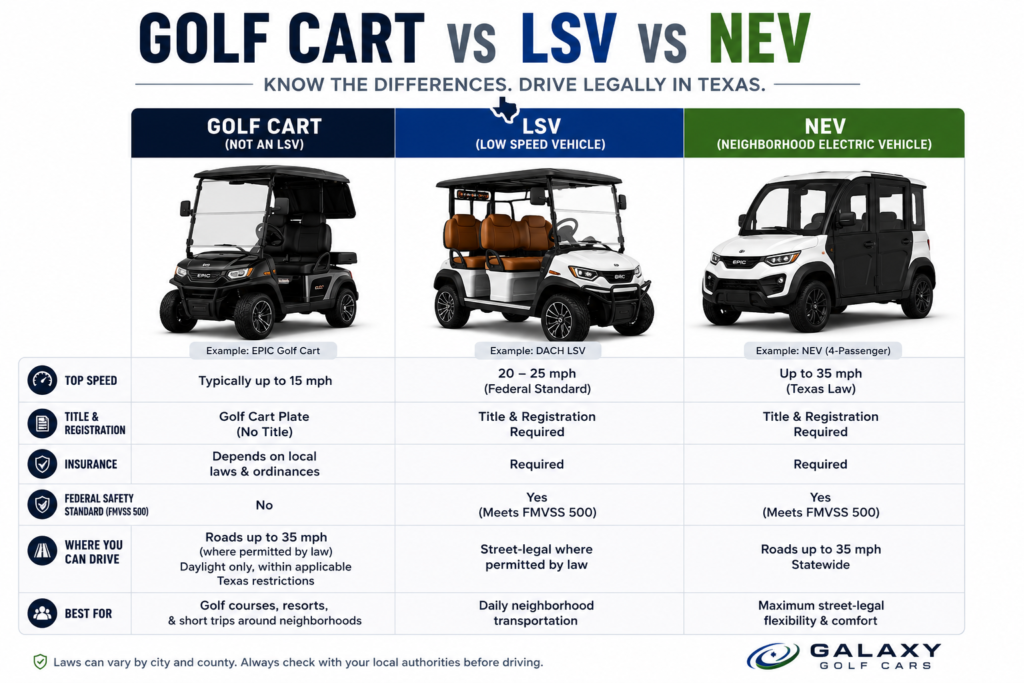
The speed distinction matters too. Standard golf carts are not regulated by federal LSV rules and often top out around 15 mph. LSVs must reach at least 20 mph and not exceed 25 mph to qualify under federal standards. Marketkeep
What About NEVs — Where Do They Fit In?
You’ll also hear the term Neighborhood Electric Vehicle, or NEV, used frequently in this conversation — and it’s worth understanding where it fits.
According to the Texas Municipal League, NEVs are larger than golf carts and are defined as vehicles capable of achieving 35 mph on a flat paved surface and complying with Federal Motor Vehicle Safety Standard 500. Fast Hippo Media
Texas recognizes NEVs as essentially street-legal carts and LSVs that are registered and plated as motor vehicles, allowed on roads up to 35 mph statewide. Fast Hippo Media
Think of it this way: an LSV tops out at 25 mph under federal rules, while a Texas NEV can reach 35 mph — and both require full registration and title, unlike a standard golf cart.
Registration and Title — The Biggest Practical Difference
This is the clearest way the golf cart vs. LSV distinction shows up in everyday ownership. For LSVs, a license and registration are required. For standard golf carts, they are not. Wickedly Awesome
Golf carts are not titled in Texas. To make one street legal, you obtain a Golf Cart license plate by filling out Form 130-U and taking it to your county tax assessor’s office — no title, no state inspection required. Fast Hippo Media
An LSV is handled completely differently. NEVs and LSVs require a valid 17-digit VIN and must be titled and registered like a traditional vehicle Fast Hippo Media — same process as registering a car or truck. That means more paperwork, more cost, and an ongoing annual registration requirement.
Insurance Requirements — Also Different
Most states permit LSVs but they must be registered, inspected, and insured, whereas golf carts have fewer legal requirements. Fast Hippo Media
In Texas specifically, the insurance picture is nuanced. Standard golf carts operated within a master-planned community aren’t always required to carry insurance under state law — but operating on public roads under a city ordinance typically triggers a minimum liability requirement. LSVs and NEVs, being registered motor vehicles, are subject to standard Texas vehicle insurance requirements.
Bottom line: if your vehicle is classified as an LSV or NEV, plan on carrying insurance. If it’s a standard golf cart, check your city’s ordinance and your HOA rules.
Where Each Can Be Driven in Texas
Both categories end up with similar practical road access in Texas — but they get there differently.
Standard golf carts can be driven on roads with speed limits of 35 mph or less, during daylight, and generally within a two-mile radius of where they are usually parked. Fast Hippo Media NEVs and LSVs, once properly registered, can be driven on 35 mph roads anywhere in Texas Fast Hippo Media — without the two-mile or daylight restrictions that apply to standard golf carts. That’s a meaningful difference if you want more flexibility in how and when you use your cart.
Can You Convert a Golf Cart Into an LSV?
Technically yes — but it’s not as simple as bolting on a few accessories.
For a golf cart to be reclassified as a Low Speed Vehicle, it must meet Federal Standard 500 requirements including a top speed between 20 and 25 mph and a full set of DOT-approved safety features including headlights, taillights, turn signals, brake lights, reflectors, side mirrors, seat belts, and a windshield. Golfcartlifestyles
Getting all of that right — and having it verified — is a more involved process than most people expect. For most buyers, the easier path is simply purchasing a vehicle that’s already manufactured and certified as an LSV or NEV from the start, rather than trying to convert a basic cart after the fact.
So Which One Should You Buy?
It depends entirely on how you plan to use it.
If you’re cruising your HOA neighborhood, making short trips within a master-planned community, or heading to and from a golf course — a standard golf cart with a license plate covers you just fine, with less registration hassle and lower upfront cost.
If you want maximum flexibility — driving any time of day, on any qualifying 35 mph road, without a radius restriction — an LSV or NEV gives you that freedom. You’ll pay more and deal with full vehicle registration, but you get broader legal access in return.
Not sure which category a specific cart falls into before you buy? The team at Galaxy Golf Cars in Plano can tell you exactly how any cart on their lot is classified under Texas law — and help you figure out which one actually fits your lifestyle before you commit.
Contact Galaxy Golf Cars Today
📍 1721 N Central Expy, Plano TX 75075
GalaxyGolfCars.com